How to start forex trading as a beginner in 2026 with a clear step-by-step plan
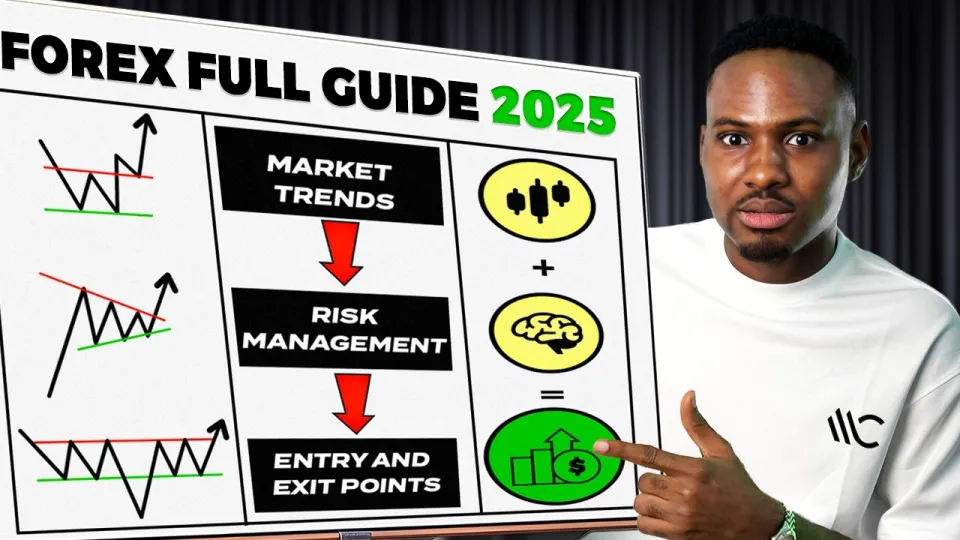
Video: How To Start Forex Trading For Beginners’ 2025 (Full Course)
You can order the same kind of articles for your own video to boost it on YouTube and Google. Just message the Telegram bot @sat_sit_bot. The bot writes and publishes the articles itself (with your YouTube video embedded) on popular topical websites (no ads). Try it free: 50 articles on us.
· based on the channel Jeffrey Benson Forex
Forex trading for beginners starts with three concrete steps: open an account with a regulated broker, learn to read a currency pair on a platform such as MetaTrader 5, and define in writing how much you are willing to risk per trade before you place it. Everything else — strategy, indicators, position sizing — is built on top of that foundation. The full beginner course from Jeffrey Benson Forex follows the same path and is available through the author's student plans at firepipsfx.com/plans.
What forex trading actually is and how currency pairs work
Forex is the exchange of one national currency for another, and every trade is quoted as a pair where the first currency is bought and the second is sold. In EUR/USD, for example, the euro is the base currency and the US dollar is the quote currency: a price of 1.0850 means one euro costs 1.0850 dollars. When you buy the pair, you expect the base currency to strengthen against the quote currency; when you sell it, you expect the opposite.
Retail traders rarely take delivery of currency. Instead, they trade contracts for difference or leveraged positions through a broker, which means the profit or loss comes from the price change, not from owning euros or dollars. That leverage is what makes forex accessible with a small deposit — and it is also what makes risk management non-negotiable.
The most actively traded pairs are EUR/USD, USD/JPY, GBP/USD and USD/CHF, often called majors because they carry the tightest spreads. Pairs without the US dollar, such as EUR/GBP or AUD/NZD, are crosses. Beginners generally do best by watching one or two majors closely rather than jumping between dozens of instruments.
How the forex market works across the trading day
The forex market is decentralised and runs continuously from Monday morning in Sydney to Friday evening in New York, which is why it is described as a 24-hour market. There is no single exchange; banks, funds and brokers quote prices to each other, and retail platforms show the aggregated result.
Liquidity and volatility change with the sessions:
- Sydney and Tokyo open the week and tend to be quieter, with the Japanese yen and Australian dollar most active.
- London is the largest session by volume and produces the biggest share of daily range in EUR/USD and GBP/USD.
- New York overlaps with London for a few hours, and that overlap is usually the most liquid window of the day.
- The late New York session thins out before the market rolls into the next day.
Macro news drives price: central bank rate decisions, inflation prints, employment data and geopolitical events can move a pair tens or hundreds of pips in minutes. A beginner does not need to forecast the economy, but should know when the calendar is loaded and either trade around those releases deliberately or stay out.
The tools every beginner needs before the first trade
A working setup for forex consists of a broker, a platform and a small set of analysis tools — not a screen full of indicators. The essentials are:
- A regulated broker account. Check which regulator supervises the entity you sign with, what leverage is offered, what the spread and commission are, and how deposits and withdrawals are processed. In the course description, Jeffrey Benson points beginners to Assex Markets as his recommended broker and links a separate guide for connecting it to MetaTrader 5.
- A trading platform. MetaTrader 5 (MT5) is the standard: it shows charts, places market and pending orders, and calculates position size in lots. A standard lot is 100,000 units of the base currency; a mini lot is 10,000 and a micro lot is 1,000, which is what most beginners should use.
- A demo account. Trade the same platform in demo mode until order entry, stop-loss placement and position sizing feel routine.
- A chart with limited indicators. A moving average or two plus support and resistance levels is enough to start. More indicators mostly create conflicting signals.
- A trading journal. Record the pair, direction, entry, stop-loss, take-profit, lot size and the reason for the trade. Reviewing entries weekly is where most learning happens.
- A risk calculator or a fixed rule. Know in advance how many pips your stop is and what that costs in dollars at your lot size.
Building a basic strategy foundation before risking money
A strategy is a written set of conditions that tells you when to enter, where to put the stop-loss and where to take profit. Without those three answers, a trade is a guess.
A simple, teachable framework for beginners looks like this:
- Pick a time frame. Decide whether you trade the daily and four-hour charts (slower, fewer signals) or the one-hour and fifteen-minute charts (more signals, more noise).
- Define direction with trend. Use a moving average or a sequence of higher highs and higher lows to decide whether you are looking for longs or shorts on that pair.
- Mark key levels. Identify recent swing highs and lows and the levels where price has repeatedly reversed.
- Set the trigger. Enter only when price reacts at your level in the direction of the trend — for example, a rejection candle at support in an uptrend.
- Place the stop-loss beyond the level that would prove you wrong, not at a round number you find comfortable.
- Set a take-profit at least as large as the stop, so that a modest win rate still produces a positive result over many trades.
The strategy does not need to be original. It needs to be specific enough that two people reading it would take the same trade, and it needs to be tested on a demo account over at least a few dozen trades before real money is involved.
Placing a first trade and sizing the position correctly
Placing a trade is a mechanical process once the plan exists. On MT5 you select the pair, choose market or pending order, set the volume in lots, attach a stop-loss and take-profit, and confirm. The part beginners underestimate is the volume calculation.
Position size follows from risk, not from ambition:
- Decide the maximum risk per trade as a percentage of the account — 1% to 2% is a common ceiling.
- Measure the stop distance in pips.
- Convert: risk in dollars divided by (stop in pips × pip value per lot) gives the lot size.
On a $1,000 account risking 1%, the maximum loss is $10. If the stop is 20 pips away and one micro lot is worth about $0.10 per pip, then 20 pips on one micro lot equals $2, so the position could be up to five micro lots. That arithmetic is the whole difference between a controlled loss and a blown account.
After entry, the trade is managed by the plan, not by emotion: the stop stays where the analysis put it, and any move to break-even follows a rule written down in advance.
Common beginner mistakes and the questions they raise
Most beginner losses come from a short list of repeatable errors rather than from bad luck. The most expensive ones are trading without a stop-loss, risking a large share of the account on a single idea, revenge trading after a loss, and switching strategies every week before any of them has a sample size.
A second cluster of problems is psychological and structural. Beginners often watch hours of tutorials and never open a demo account, or they copy signals without understanding the risk behind them — which is why the course description offers both a free daily signal channel and a premium group, and why copying trades is only sensible when the position size fits your own account. Others over-leverage because a broker advertises high leverage, or trade during major news releases without accounting for widened spreads and slippage.
A third mistake is measuring progress by one trade. A strategy is judged over 50 or 100 trades; a single win or loss says almost nothing. Keeping the journal and reviewing it weekly turns that lesson into a habit.
Useful links from the course
- Student plans and the full course
- Free daily signal channel on Telegram
- Broker registration link used in the course
- Premium signal group access
The realistic path from first demo trade to consistent process
Starting forex trading is a sequence of small, checkable steps: choose a regulated broker, learn the platform on demo, write a strategy with entry, stop and target rules, size every position from a fixed risk percentage, and journal the results. None of those steps requires a large deposit, and all of them can be completed before real money is at risk. The beginner course from the Jeffrey Benson Forex channel is structured around exactly this order — market basics, tools, strategy, first trade, mistakes — and pairs it with a free signal channel so learners can watch decisions being made in real time. Treat the signals and the student plans at firepipsfx.com/plans as support for your own process, not as a replacement for it. Consistency in risk and record-keeping is what separates traders who survive their first year from those who do not.
Key takeaways
- Forex is the market where national currencies are traded in pairs, such as EUR/USD; retail traders usually access it through a broker's platform like MetaTrader 5.
- The market runs 24 hours a day, five days a week, moving between the Sydney, Tokyo, London and New York sessions.
- A beginner needs three things to start: a regulated broker account, a trading platform and a written risk plan.
- Risk per trade should be small and fixed, typically 1-2% of account equity, with a stop-loss set before entry.
- Jeffrey Benson Forex's full beginner course covers market basics, tools, a basic strategy foundation, a first trade and common mistakes.
Source: How To Start Forex Trading For Beginners’ 2025 (Full Course) · Markdown version
Questions & answers
How much money do I need to start forex trading?
You can open many accounts with a few hundred dollars, and micro lots let you trade with tight risk on a small balance. What matters more than the deposit is that your risk per trade stays at 1-2% of the account, so a small account simply means smaller positions. A demo account costs nothing and should come first.
Is forex trading suitable for complete beginners?
Yes, provided the beginner treats it as a skill built over months rather than a shortcut to income. The core mechanics — pairs, lots, stop-losses, position sizing — can be learned in a few weeks, but applying them consistently takes practice on demo and then on a small live account. Starting with one major pair and one written strategy keeps the learning curve manageable.
How much time per day does forex trading require?
It depends on the time frame. Higher time frames such as the daily and four-hour charts need perhaps 30-60 minutes a day for analysis and trade management, while intraday trading during the London-New York overlap demands several hours of screen time. Beginners usually do better with fewer, larger-time-frame trades than with constant monitoring.
Can I copy someone else's trades instead of learning to trade?
Copying signals is possible, but it does not remove risk: you still need to size positions to your own account and understand where the stop-loss sits. Signal services, including the free channel offered alongside the course, work best as a learning aid or a supplement to your own plan. Without risk control, copied trades can lose money just as quickly as self-directed ones.